Between Downs Crew Card
The whistle, the spot, the ball and the chains — the work between plays that makes a crew look sharp. For crews of five and crews of four.
Download the Between Downs Crew Card (PDF, 2 pages) — print at 100% on Letter, two-sided, flip on the long edge.
Built from the OHSAA Gold Book Brief & Concise mechanics for crews of 5 and 4, which follows the NFHS Officials Manual. Associations amend these — check Vermont's guidance before teaching it.
Who's who
| Position | |
|---|---|
| R | Referee (white hat) |
| U | Umpire |
| LM | Linesman (H/DJ) |
| LJ | Line Judge |
| BJ | Back Judge (5-man only) |
Boxed items on the card are white-hat only, and appear below under "Referee — white hat only."
The whistle and the dead ball
See leather · the ball is dead.
Everyone on this
- See leather. One short strong blast — not more than two, rarely three. Whistle on every play, no exceptions.
- Keep it in your mouth until the threat of a dead-ball foul is gone. Carry it in your hand during the down, not your mouth.
- Swivel your head twice and watch the players in your area instead of staring at the spot. Then raise an arm immediately for the next down.
- Repeated blasts mean a foul away from the play, a timeout, a coach who needs you, or opponents talking to each other.
Referee — white hat only
- You rarely need to run to the dead-ball spot at or beyond the line. Stay back, swivel twice, then get to your position.
- Mark the ball ready only when you are clear of all players.
- On a loose ball, stop the clock after two seconds if nobody has signalled possession.
Who does what
| Crew of 5 | Crew of 4 | |
|---|---|---|
| R | Whistle discipline for the crew. Wind the clock when a crewmate signals it. | Same, plus the play clock. |
| U | Strong voice after the whistle — it prevents more fouls than a flag does. | Same, and you cover the middle alone. |
| LM / LJ | Runner out of bounds: stop the clock twice immediately, then turn and watch. Swivel and watch them come back in. | Same as a crew of 5. One of you takes the opponent's bench area. |
| BJ | A player in the opponent's bench area: go into the team box and escort him back. | — |
Plastic whistle only. A finger whistle is fine, but you still owe approved signals with both arms.
Forward progress and the spot
Runner is down · mark it.
Everyone on this
- Downfield foot in front of the backfield foot. Square off. No angling in.
- Wings mark most spots. The Referee takes it behind the line; the Back Judge takes it deep.
- Driven back between the numbers and the sideline: wind twice and move in — not past the players.
- Trapped pass: go slow. Squaring off and moving in says catch, so don't move until you know it is one.
Referee — white hat only
- You mark progress behind the line. Everywhere else, let the covering official own it.
- Once a whistle sounds for progress, everyone swivels twice for dead-ball action.
- Wings that hug the sideline and never come off it are pretenders. Get them off it without running through players.
Who does what
| Crew of 5 | Crew of 4 | |
|---|---|---|
| R | — | Behind the line only. |
| U | Dig for the ball when the wings need it, and hand it over — never throw or toss it. | Same, plus deep progress in the middle. |
| LM / LJ | Cross-field help on passes and on a runner driven back near the sideline. The backside wing moves into the field toward the hash so your partner can actually see you. | Same as a crew of 5, with no help behind you. |
| BJ | Mark progress downfield, and relay the new ball as part of the triangle. | — |
Getting it back in play
Ball is dead · spot it and go.
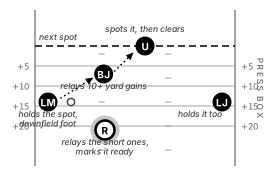
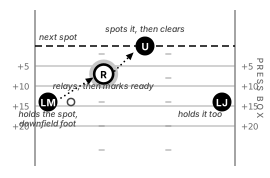
Everyone on this
- Wings never spot the ball in the side zone. Mark it with the downfield foot and hold it for the Umpire.
- The relay runs wing to middle to Umpire. Take the extra step rather than throwing it, and never throw it toward a sideline so it hits the ground.
- Watch dead-ball action first. Hunting a new ball while a foul happens behind you is how crews get beaten.
- Hurry-up: one ball as much as you can, and both wings hold the spot — the Umpire may take either one.
Referee — white hat only
- Hurry-up: don't move in as far when the ball is dead, and back-pedal to your position before you mark it ready.
- If the centre is over the ball before you're ready, tell him and the quarterback to wait for your whistle.
- The goal is that they never wait on us, except for a timeout or a measurement.
Who does what
| Crew of 5 | Crew of 4 | |
|---|---|---|
| R | — | You are the relay on every play, then you mark it ready. |
| U | The sprinter between downs. Grab it, spot it off the backside wing, shoulders parallel to the sideline, then move off quickly. | Same as a crew of 5. |
| LM / LJ | Hold the dead-ball spot. Do not spot it in the side zone. | Same as a crew of 5. |
| BJ | Relay on gains of about ten yards or more. On a deep incomplete pass, hustle it off the field while the wings get a new one. | — |
Change of possession: relay the old ball out once there's no threat of a dead-ball foul. Inclement weather: shorter relays, run it in when needed, towel over the ball at the spot.
First down and measuring
It looks close.
Everyone on this
- The Line Judge decides. If it's close, stop the clock and look. If it isn't, start it.
- Close means measure. Refuse once and you'll be wrong all night in the coaches' eyes.
- Wings sprint in until they meet resistance. Whoever can see leather yells for the ball; the Umpire digs it out and hands it over.
Referee — white hat only
- Wings know the line to gain before the snap and point it out to each other. On third and fourth down, make sure they do.
- Signal the first down immediately, once. No chopping.
- Inbounds near the sideline on a first down: timeout signal only — nobody winds.
Who does what
| Crew of 5 | Crew of 4 | |
|---|---|---|
| LJ | Primary on the first down — best look from across the field, and usually downfield. Secure a new ball after marking the spot for the chains. | Same as a crew of 5. |
| LM | Do not look over your shoulder. Hold your spot and let the Line Judge rule it. | Same as a crew of 5. |
| U | Dig for the ball and hand it to the wing. | Same as a crew of 5. |
On a synthetic or well-marked grass field, if the forward stake is beyond a hash and the spot is behind the same hash, don't measure. In a crew of 4, when the line to gain is five yards or less, move to it at the snap the same as goal line mechanics — be standing on it before the ball arrives.
Bags, hats and loose balls
What comes out of your pocket, and when.
- Fumble: blue bean bag up in the air at chest level. A bag in the air tells the crew the ball is loose and keeps whistles out of mouths. Get it on the correct yard line, not exactly at the spot.
- No bag for an interception, or for a backward pass behind the neutral zone. Beyond the neutral zone, bag the backward pass.
- Momentum inside the 5: drop the bag at the spot of the catch or the interception.
- The Back Judge carries two — the end of a scrimmage kick and first touching. No bag at an out-of-bounds spot on the sideline.
- Hat, not flag, when an A or K player goes out of bounds on his own. Muddy field: keep the hat and yell the number loudly.
- Change of possession: the covering official signals the new direction twice, then the timeout twice. Everyone else mirrors the timeout the moment they see it. On a pile, whoever rules possession yells the team colour.