Fouls & Enforcement Crew Card
MechanicsCrew CardsRulesPrintable
Who throws it, who enforces it, who announces it. For crews of five and crews of four.
Download the Fouls & Enforcement Crew Card (PDF, 2 pages) — print at 100% on Letter, two-sided, flip on the long edge.
Built from the OHSAA Gold Book Brief & Concise mechanics for crews of 5 and 4, which follows the NFHS Officials Manual. Associations amend these — check Vermont's guidance before teaching it.
Who's who
| Position | |
|---|---|
| R | Referee (white hat) |
| U | Umpire |
| LM | Linesman (H/DJ) |
| LJ | Line Judge |
| BJ | Back Judge (5-man only) |
Flag down
You see a foul · the ball is still live.
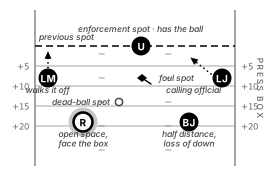
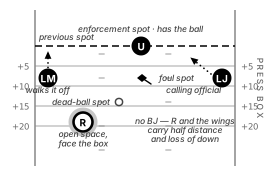
Everyone on this
- No spot: throw it high in the air. Spot matters: throw it to the yard line. Passer beyond the line: drop it at the spot. Never throw a flag at a player.
- A dead-ball personal foul or an unsportsmanlike foul goes straight up in the air.
- Two flags on one foul: move them to the same spot, confirm the foul and the number, then one official gives the preliminary.
Referee — white hat only
- Referee dead-ball action first. Penalize the first late hit — it usually ends the problem.
- Find the first open space and give your preliminary there. Do not walk around looking for a spot.
- You give one preliminary only for a simple five-yard dead-ball foul: false start, encroachment, delay, illegal substitution.
Who does what
| Crew of 5 | Crew of 4 | |
|---|---|---|
| Calling official | Timeout twice, the preliminary to the Referee, then point at the offending team. Describe it to the wing — "#88 held" won't sell it. | — |
| R | — | Same, and half distance and loss of down are yours. |
| U | Turn to the calling official on the whistle. Enforcement is yours from there. | Same as a crew of 5. |
| LM / LJ | Cover a spot foul. Keep the sideline clear. | Same, and the Line Judge picks up clock status to the Referee. |
| BJ | Half distance, automatic first down, loss of down. | — |
Flag in front, tucked in — one or two, centre weighted, black ball.
Enforcing it
Ball is dead · flag is down.
Everyone on this
- Both wings walk off the yardage — one will get pulled into a coach's question, so two sets of feet keep it honest.
- The wing gives the head coach the down and distance both ways: taking it, and declining it.
- Ask your question now. A wrong enforcement gets fixed on the field, not in the locker room.
Referee — white hat only
- Enforcement belongs to the Umpire. Let him work it; you take the preliminary and the announcement.
- Crew goal on a simple five-yard dead-ball foul: ball marked ready inside ten seconds.
- Check the scoreboard for the right number of timeouts before you mark it ready.
Who does what
| Crew of 5 | Crew of 4 | |
|---|---|---|
| R | — | Half distance, automatic first down and loss of down are yours. |
| U | 98% of the time you already know it. On the other 2%, look to the head coach with the wing beside him. Walk it or jog it, but get it right. | Same as a crew of 5. |
| LM / LJ | Both walk it off. Don't look at the Umpire until you reach the succeeding spot. Five-yard walk-off near a first down: check the chain tape. | Same as a crew of 5. |
| BJ | Half distance, automatic first down, loss of down — say it out loud, it gets missed. | — |
Announcing it
Preliminary given · enforcement set.
Everyone on this
- The microphone belongs to the Referee alone. If the crew can't hear it in the stadium, nobody uses it.
- Line Judge and Back Judge signal clock status to the Referee while he faces the press box.
Referee — white hat only
- Stand still, face the press box, be concise. Think before you talk and pause for effect.
- Announce the player's number. Keep unique rulings short and skip the technical language.
- No microphone tonight? Verbalize the foul as you signal to the press box.
Say it like this
| Dead ball | Dead ball, false start, #79, offense, five yards, still first down. |
| Live ball | Illegal motion, #38, offense, five yards, repeat second down. |
| Automatic first | Pass interference, #41, defense, 15 yards, automatic first down. |
| Loss of down | Intentional grounding, #12, offense, five yards, loss of down, third down. |
Also announced
| Sideline warning | Sideline warning, name the school, their first. |
| Timeout | Timeout, offense, their first. |
| Out of timeouts | Two tugs on the steamboat whistle facing the press box, then point at that team's goal line. |
| Disqualification | Signal the DQ for each player ejected, on each team. |
Coach wants a conference
Rule 3-5 · he thinks a rule was misapplied.
Everyone on this
- This covers misapplication or misinterpretation of a rule. Judgment calls do not qualify — say so plainly and move on.
- The rule book, the case book and the mechanics manual have to be at the field. Not in the car.
- If he still disagrees, the crew gets the books, finds the ruling and shows him. Skipping this can cost an official up to two years.
Referee — white hat only
- Meet him at the sideline with the wing present, and listen before you talk.
- You can take it to the crew. Every official gets to speak — don't let the loudest one run the discussion.
- You explain the ruling to the coach, not the official who called it.
Who does what
| Crew of 5 | Crew of 4 | |
|---|---|---|
| R | Runs the conference and gives the ruling. Facilitates the crew discussion. | Same as a crew of 5. |
| LM / LJ | Stay with the Referee at the sideline. Keep the coach in his box and everyone else out of it. | One stays with the Referee, the other watches both teams. |
| U / BJ | Get the books, and watch the field — the players are unsupervised while this happens. | The Umpire gets the books. |
Tempers up
Prevention is the job; the fight is the failure.
- Allow no talking between opponents. Stop it the moment it starts. Pinch further into the field — your presence does the work, and the Umpire matters most in the middle.
- Penalize the first late hit. It is the single most effective thing you can do, and it usually ends the problem.
- Two players chest up or shove: get between them and stop it, then decide on penalties. Talk to the ones on the edge of a late hit but not late enough to call.
- Be assertive without being aggressive. Do not push a player down, tackle him, grab a facemask or pull anyone off a pile. Use the whistle.
- Players actually swinging: stand back and take numbers, keep others away, break it up once they are on the ground. Wings own the sidelines and keep the benches from emptying.
- After order is restored: huddle away from everyone, let every official speak, then assess penalties and disqualifications. The Referee tells each head coach at the sideline with a wing present. Signal dead ball and personal foul — not unsportsmanlike, there was contact.