Line Judge Position Card
MechanicsPosition CardsPrintable
Your spot, your keys and your reads, situation by situation — the Line Judge's card for a crew of five. You work the press box sideline and you own the clock. You are the white marker on every diagram.
Download the Line Judge Position Card (PDF, 2 pages) — print at 100% on Letter, two-sided, flip on the long edge.
Built from the OHSAA Gold Book Brief & Concise mechanics for a crew of 5, which follows the NFHS Officials Manual. Associations amend these — check Vermont's guidance before teaching it.
Who's who
| Position | |
|---|---|
| R | Referee (white hat) |
| U | Umpire |
| LM | Linesman (H/DJ) |
| LJ | Line Judge — you |
| BJ | Back Judge |
Run and pass
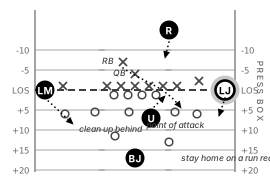
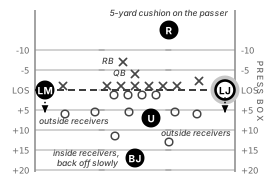
Snap between the –10 and the +10.
What you do
- Ten yards outside the widest A player, never inside the numbers. If A is near the sideline, take steps out of bounds.
- You have primary responsibility for the game clock. Talk to the timer before the game.
- Know the line to gain before the snap and point it out to the Linesman on third and fourth down.
- Count the players on the line on your side of centre and signal the Linesman. Punch off the nearest player who's off it.
Your keys
- Run — snap · line play · blocks downfield · the runner.
- Pass — snap · player(s) · QB · zone · ball. The outside receivers are yours.
- Read the guard and tackle first, then the quarterback's eyes. His first look is usually where it goes.
- The sideline is yours, goal line to goal line.
The three pass reads, in order
- Flat / bubble — Stay home. Don't move until this read is done.
- Short / medium — Move downfield five, shoulders parallel, then stop. Adjust for a five-yard cushion from the receiver.
- Long — Turn and burn.
Straddle the sideline on a sideline catch. Give the catch signal only on the sideline — never into the field.
The clock is yours
| Before the game | Talk with the timer. You time halftime, weather delays and the interval before overtime. |
| Restart | Make sure the scoreboard actually starts after the signal. If it doesn't, everyone signals. |
| Down box wrong | Point above the Linesman's head repeatedly. Soft whistle only if you must. |
| With the Referee | Signal clock status while he faces the press box. |
Kicks
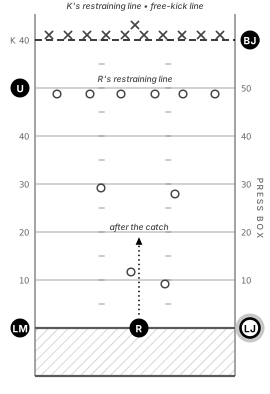
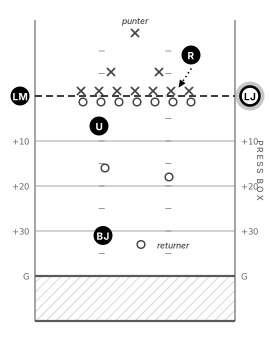
Free kick and scrimmage kick.
What you do
- Kickoff: the goal line on the press box sideline. Stand at the field numbers with a stop signal to the Referee until the clock reads 12:00.
- Move up to the 10 if that team's first kick fell short of the 15. Trail the runner by at least five yards.
- Punt: straddle the line of scrimmage until the kick crosses it — use the down box as your reference.
- Stay on your sideline on a punt; an out-of-bounds kick is live for you.
Your keys
- Kickoff — R touching the kick · wind · K out of bounds · blocks immediately ahead of the returner.
- Punt — snap · line play · blocking backs · the kick crossing the line · blocking.
- Wind the clock only if the kick is caught or touched in your side zone.
- Kick out of bounds: flag at the spot, then hustle to the head coach for his choice.
Your spot
| Kickoff | Goal line, press box sideline. |
| Onside | Up to the 50, your sideline. Officiate it as a plane. |
| Punt | Straddling the line until the kick crosses it. |
| Safety kick | The receivers' 30. |
After the punt
| 30 yards or less | Jog downfield 10, then stop and watch. |
| More than 30 | Jog downfield 15 to 20. |
| Rolls out deep | Look to the Back Judge — he has the angle and he won't come to the sideline. |
| Tipped | Give the tip signal twice. |
Goal line and place kicks
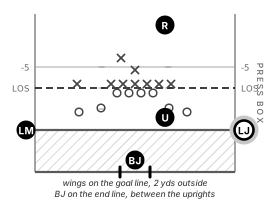
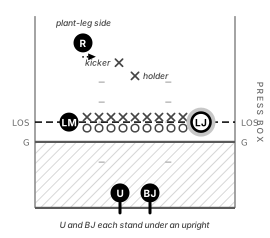
Snap on or inside the +10 · tee on the field.
What you do
- Goal line: two yards outside the sideline, on the goal line. Be standing on it before the ball arrives.
- You have primary responsibility for deciding a close first down. If it's close, stop the clock and look; if it isn't, start it.
- Close means measure. Secure a new ball after you mark the spot for the Linesman and the chains.
- Field goal and try: stand on the field numbers at the line of scrimmage.
Your keys
- Place kick — snap · fake · the near tight end or wingback block.
- Never mirror a touchdown signal. Eye contact first.
- Be patient and find the ball before you sell anything.
- Fake on a try short of the goal line: mark forward progress only.
Your spot
| Goal line | 2 yds outside the sideline, on the goal line. |
| FG / try | On the field numbers at the line. |
| Muddle huddle | 2 yds out of bounds, then hustle to the numbers if they shift to a kick. |
| Fake | Move immediately to the goal line, 2 yds outside the pylon. |
First down
| You decide | Best look from across the field, and you're usually downfield. |
| Close | Stop the clock and look. Then measure if it's close. |
| Don't measure | Forward stake beyond a hash and the spot behind the same hash, on a well-marked field. |
| Sprint in | Until you meet resistance. Yell for the ball if you can see leather. |
Between downs, clock and fouls
Every down, all night.
What you do
- Never spot the ball in the side zone. Mark it with your downfield foot and hold it for the Umpire.
- Runner out of bounds: stop the clock twice immediately, then turn and watch.
- Both wings walk off penalty yardage, and the wing tells the head coach the down and distance both ways.
- Sidelines are yours in a fight — keep non-players from leaving the bench.
Your keys
- Wind twice when the spot is inbounds between the numbers and the sideline, unless it's an obvious first down.
- Inbounds near the sideline on a first down: timeout signal only — nobody winds.
- Cross-field help: move into the field toward the hash so your partner can see you.
- Hat, not flag, when an A or K player goes out of bounds on his own.
Clock duties
| Two minutes | Somebody must actually see the scoreboard stop. Say who. |
| Broken clock | Announce the time at nine, six, four and two minutes, loudly. |
| TV game | Hold the Referee and Umpire with a stop sign until the coordinator says they're ready. |
| Out of timeouts | Tell the head coach. |
Housekeeping
| Substitutes | Off the field on your sideline before the snap. |
| Measurement | Secure a new ball once the spot is marked. |
| Coin toss | Press box side with the Back Judge. Delay until the far side reaches the numbers. |
| 5 yards or less | Move to the line to gain at the snap. |
When you work a crew of 4
What changes for you.
- You pick up clock status to the Referee — whether it starts on the ready or the snap. That's the Back Judge's job in a crew of 5.
- Kickoff: you're at the 50 on the press box sideline, not the goal line.
- Pass: every receiver on your side is yours, and the middle is dual coverage with the Linesman.
- Punt: you still hold the line until the kick crosses it, but the Umpire is deep instead of a Back Judge.
- Goal line: step into the end zone to see a catch near the end line — nobody is on it.